


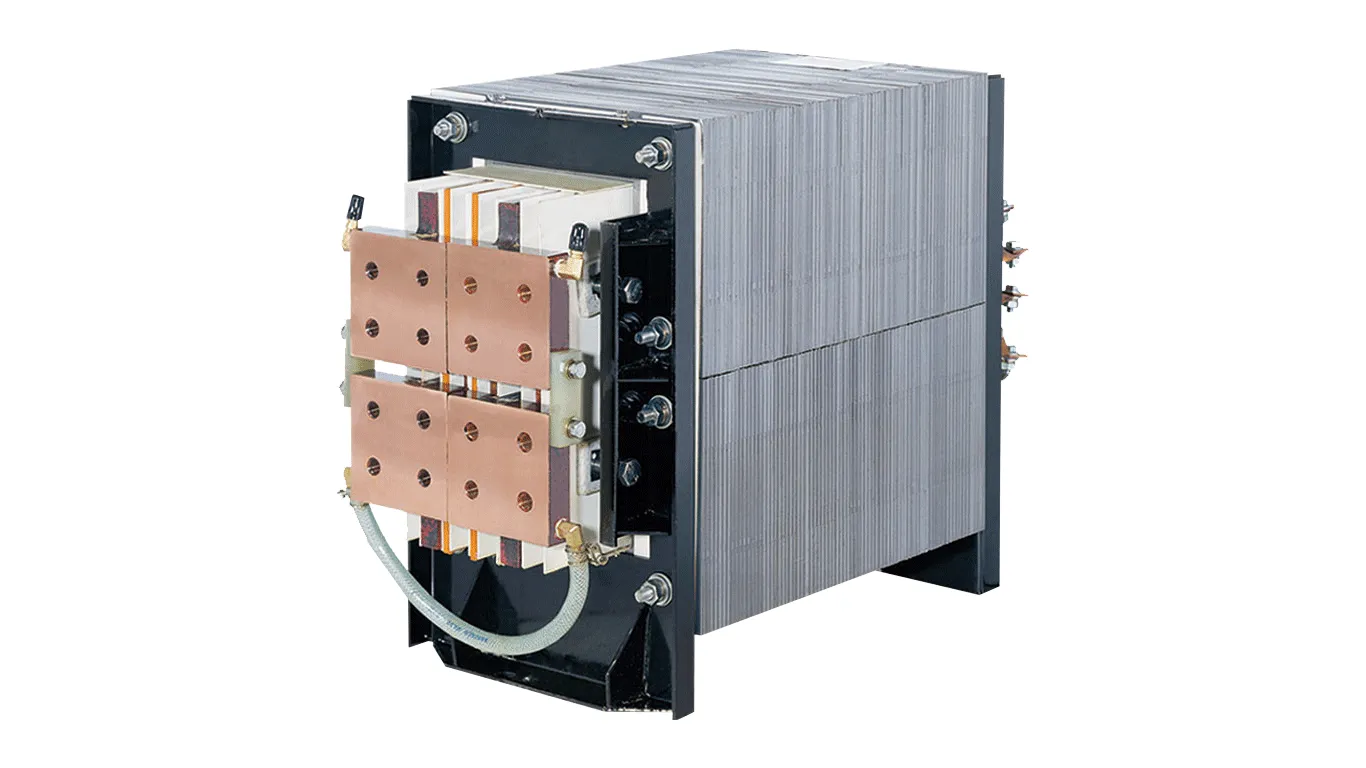
What is a transformer or transformer or transformer?
A transformer is an electrical device used to change electrical voltage and current. It consists of two coils of wire wound around a common core. By changing the number of turns in the coils, the voltage and current can be changed.
Transformers come in many different types, including:
– Step-up transformers: increase the voltage.
– Step-down transformers: reduce the voltage.
– Isolation transformers: are used to isolate electrical circuits.
Transformers are used in many electrical applications, including power distribution, industry, and household appliances.
Water-cooled and air-cooled transformers
Water-cooled and air-cooled transformers are two types of electrical transformers that are used to cool the transformer core and prevent overheating.
Water-cooled transformers
Water-cooled transformers use water as a coolant. The water, through a cooling system, cools the transformer core and removes heat from it.
Applications:
1. **Welding machines**: Water-cooled transformers are used in resistance welding machines, such as spot welding machines and block beam welding machines.
2. **Heavy industries**: These transformers are used in heavy industries, such as the steel and chemical industries.
Air-cooled transformers
Air-cooled transformers use air as a coolant. The air cools the transformer core and removes heat from it through a cooling system.
Applications:
1. **Electronic Devices**: Air-cooled transformers are used in electronic devices, such as computers and network equipment.
2. **Light Industries**: These transformers are used in light industries, such as the electronics and medical industries.
Advantages:
1. **High efficiency**: Water-cooled and air-cooled transformers have high efficiency.
2. **Long life**: These transformers have a long life.
Disadvantages:
1. **High cost**: Water-cooled and air-cooled transformers have a high cost.
2. **Complicated maintenance**: These transformers require complex maintenance.
Water-cooled and air-cooled transformers are two types of electrical transformers that are used to cool the transformer core and prevent overheating. These transformers are used in various devices, including welding machines and electronic devices.
What is a resistance welding machine transformer?
Resistance welding machine transformers
Transformers in resistance welding machines are a vital component in these machines. These transformers play an important role in providing electrical energy for the resistance welding process.
Transformer functions in resistance welding machines
1. **Voltage reduction**: Transformers reduce the input voltage to reach the voltage required for welding.
2. **Current increase**: Transformers increase the electric current to reach the current required for welding.
3. **Voltage and current stabilization**: Transformers stabilize the output voltage and current to ensure a stable welding process.
Characteristics of transformers for resistance welding machines
1. **High power**: Transformers for resistance welding machines usually have high power.
2. **High efficiency**: These transformers must have high efficiency to convert electrical energy effectively.
3. **Rugged structure**: Transformers for resistance welding machines must have a sturdy and heat-resistant structure.
Types of transformers for resistance welding machines
1. **Single-phase transformers**: For single-phase resistance welding machines.
2. **Three-phase transformers**: For three-phase resistance welding machines.
Applications
Resistance welding machine transformers in various industries such as:
1. **Automotive industries**: For welding automotive parts.
2. **Aeronautical industries**: For welding aircraft parts.
3. **Construction industries**: For welding metal structures.
Transformers in resistance welding machines are one of the vital components in these machines. These transformers play an important role in providing electrical energy for the resistance welding process and must have certain characteristics such as high power, high efficiency, and robust structure.
The resistance welding transformer is an important component in resistance welding machines. In resistance welding, a high-intensity electric current passes through the workpiece, causing heat and melting of the metal. The transformer of the resistance welding machine is responsible for bringing the electric current to the required level.
This transformer usually consists of a magnetic core and primary and secondary windings. The primary winding is connected to the power source and the secondary winding is connected to the workpiece. As current passes through the primary winding, a magnetic field is created, which induces an electric current in the secondary winding.
The transformer of a resistance welding machine can be a step-down or step-up transformer, depending on the needs of the welding machine. In some resistance welding machines, the transformer can be a transformer with a different transformation ratio.
In general, the resistance welding machine transformer is a vital component in resistance welding machines and plays an important role in generating heat and melting metal.
What is a water cooled transformer and what are its types:
A chilled water transformer is a device used to cool water in various systems such as cooling towers, chillers, etc.
Types of water-cooled transformers include:
Plate chilled water transfer,
shell and tube chilled water transfer,
double-tube chilled water transfer.
These equipments are used for heat transfer and water cooling and are used in various industries such as air conditioning, power plants, and chemical industries.
What is resin and resinless transformer and what is its application:
Cast resin and resinless transformers are two types of transformers used in the electrical industry.
Cast Resin Transformer: A cast resin transformer is a type of transformer in which the core and windings are coated with resin. Resin is a polymer material that is used as an insulator and protector. These types of transformers are resistant to moisture, heat, and other external factors.
Resin-free transformer: A resin-free transformer is a type of transformer in which the core and windings are not coated with resin. These types of transformers are mostly used in domestic and low-voltage applications.
Applications: Resin and resin-free transformers are used in various applications, including:
Power distribution
Electronics industries
Medical equipment
Security systems
Both types of transformers have their advantages and disadvantages. The choice between them depends on the specific needs of the project and the conditions of use.
A water-cooled transformer consists of components designed to cool the transformer using water. Some of its main components are mentioned below:
1. **Main transformer**: This part includes the coils and the transformer core, which is responsible for converting electrical voltage and current.
2. **Coils**: Transformer windings, usually made of copper or aluminum.
3. **Core**: The transformer core, usually made of iron or ferrite.
4. **Water cooling system**: This system includes pipes, a water pump, and a heat exchanger that is used to cool the transformer.
5. **Heat exchanger**: This part transfers the heat generated in the transformer to water.
6. **Water pipes**: Pipes that transport water from the source to the transformer and then to the cooling system.
7. **Water Pump**: A pump that pumps water from the source to the transformer cooling system.
8. **Temperature controllers**: These parts control the temperature of the transformer and water to prevent overheating.
9. **Body**: The transformer body, which includes all of the above parts and is usually made of steel or aluminum.
10. **Electrical Connections**: Electrical connections used to connect the transformer to the electrical grid and electrical loads.
These components are generally found in water-cooled transformers and are used to cool the transformer and prevent temperature rise.
Transformers from 20 to 1200 kVA
Transformers are a vital component in electrical systems and play an important role in the transmission and distribution of electrical energy. Transformers from 20 to 1200 kVA (kilovolt-amperes) are used in various industries and power distribution systems.
20 kVA transformer
– **Application**: To power small and medium loads such as:
– Street lighting.
– Small buildings.
– Electrical equipment in small workshops.
100 kVA transformer
– **Application**: To power medium loads such as:
– Large residential buildings.
– Small commercial centers.
– Light industrial equipment.
200 kVA transformer
– **Application**: For powering medium to large loads such as:
– Small and medium industries.
– Hospitals.
– Educational centers.
400 kVA transformer
– **Application**: To power large loads such as:
– Medium industries.
– Large commercial centers.
– Heavy industrial equipment.
800 kVA transformer
– **Application**: For powering very large loads such as:
– Large and heavy industries.
– Manufacturing centers.
– Very heavy industrial equipment.
Transformer 1200 kVA
– **Application**: For powering very large and industrial loads such as:
– Very large and heavy industries.
– Large manufacturing centers.
– Very heavy and advanced industrial equipment.
Transformers from 20 to 1200 kVA are used in various industries and power distribution systems. The selection of the appropriate transformer depends on the type and size of the electrical load. These transformers play an important role in the transmission and distribution of electrical energy and should be selected according to the needs of the electrical system.
Single-phase and three-phase transformers
Transformers are a vital component in electrical systems and play an important role in the transmission and distribution of electrical energy. Transformers are divided into two main types based on the number of phases: single-phase transformers and three-phase transformers.
Single phase transformer
A single-phase transformer is a transformer that operates on a single electrical phase. These transformers are typically used to power single-phase loads such as household appliances and small electrical equipment.
Three-phase transformer
A three-phase transformer is a transformer that operates on three electrical phases. These transformers are commonly used to power three-phase loads such as electric motors and industrial equipment.
Advantages and disadvantages
Single-phase transformer:
– **Advantages**:
– Simpler and less expensive.
– Suitable for single-phase loads.
– **Disadvantages**:
– Suitable only for single-phase loads.
Three-phase transformer:
– **Advantages**:
– Can power three-phase loads.
– Widely used in industrial and power systems.
– **Disadvantages**:
– More complex and expensive.
Applications
– **Single-phase transformer**: In household appliances, small electrical equipment and lighting systems.
– **Three-phase transformer**: In industries, electric motors, industrial equipment and power distribution systems.
Single-phase and three-phase transformers are the two main types of transformers, which differ based on the number of phases. The choice between these two types of transformers depends on the type of load and the needs of the electrical system
